HOW TO CHOOSE AN ARMCHAIR?

How do you recognise a high-quality, ergonomic armchair? Which upholstery fabric is easy to clean? What should you look for when choosing a fabric? And how do you make the most lasting choice? This post answers these and many other questions.
What do you need it for? A question of function.
When choosing an armchair, start by asking where and what you need it for. If you are looking for a chair for a reading nook, for crafts or for working on a laptop, think about ergonomics first. In that case a chair with a higher backrest is usually a better fit – make sure your back is well supported and the armrests are at a comfortable height.
If you need an armchair as extra seating in the living room, it can have either a high or a low backrest. A low backrest keeps the room feeling open and works well when you have two or more chairs. A high backrest brings a new rhythm to the room, and a seating position different from the sofa offers a nice change. Having the sofa and armchair from the same series is not always the most important thing – armchairs in a different shape from the sofa often give a room its character. For a special accent, choose an armchair with a more sculptural, distinctive form.

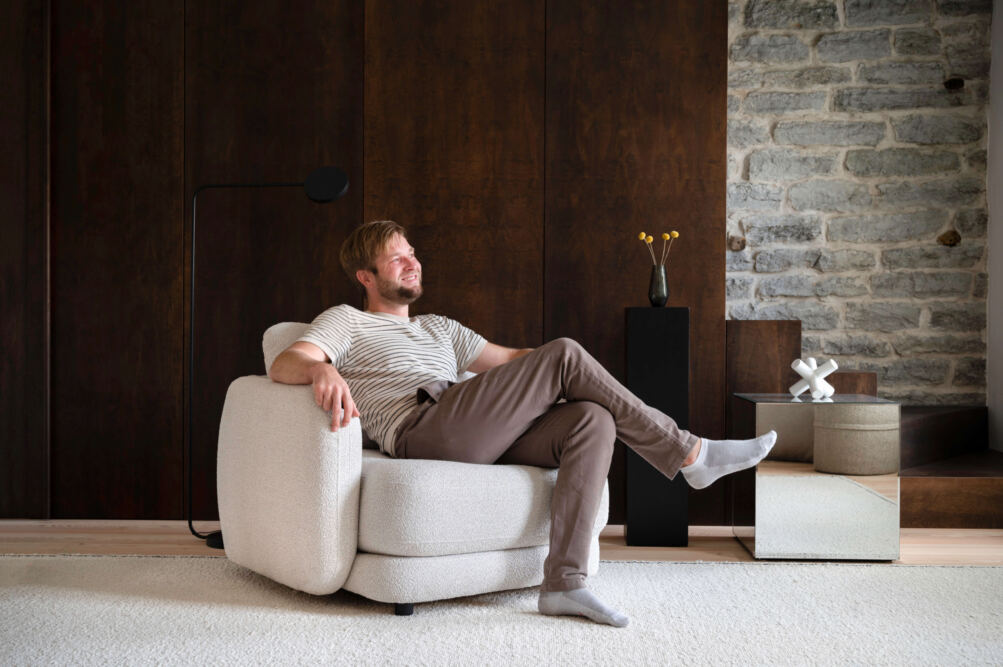
BOHO is a very soft and comfortable armchair with a deep seat. Its seat cushion has pocket springs that give it a particularly pleasant softness and help prevent the cushion from sagging. This sculptural armchair is a great companion to the BOHO sofa or a cosy addition to the bedroom. A big plus is its design: the BOHO armchair looks good from every angle.
Ergonomics
Armchairs differ in ergonomics, so to find the right one you need to decide whether you prefer something softer or firmer – a chair with a deep seat for lounging, or one with a more upright position. Chairs padded with down and with foam feel very different. Neither is simply better; you just need to try them and find the one you like best. Comfortable armchairs usually have a seat that tilts slightly towards the backrest. The tilt is small, but it makes a big difference to how the chair feels. A good armchair also gives proper lower-back support.
Ergonomics is a science. Everyone is different, and so are our sitting habits and expectations of comfort. Some people prefer a firm chair that supports the back well, others want it as soft as possible. That is why it is worth trying as many armchairs as you can to find the best fit.

The OOT-OOT Studio VOOG armchair and footstool have particularly good ergonomics. The backrest is designed to support the back and head in exactly the right places. The frame is made of metal using moulded-foam technology – the same technology used for aircraft and train seats, which must not sag even after 10 years. With home use, a construction like this lasts for decades. The armchair is also available with metal legs.
Upholstery fabrics
Good upholstery fabrics are highly abrasion-resistant, repel dirt, are easy to clean and are environmentally friendly. OEKO-TEX® and EU Ecolabel certified fabrics are tested, free of harmful chemicals and made in conditions that respect people and nature. When choosing a fabric, check its composition and abrasion resistance (Martindale test), which for home use should be at least 35,000. Cotton fabrics are the most delicate, while blended and acrylic fabrics tend to pill. The more textured the fabric, the harder it is to clean. Polyester fabrics are the easiest to care for and the most durable. At OOT-OOT Studio you can consult our designers, who work with fabrics every day and can guide your choice, taking into account your lifestyle, pets, small children and the look of your room.

The FLOYD armchair is a great companion to the FLOYD sofa. Its deep seat lets you curl up comfortably.
Quality and materials
An armchair lasts when its frame is made of metal, or of solid wood and plywood. Chipboard is not the best choice for armchair construction. It is very important to use durable foams, ideally HR (high-resilience) foam. Cheap foams sag within a couple of years. Quality foams soften a little, but keep their shape for years. Seat cushions should rest on metal zigzag springs, not on rubber webbing that stretches over time.

The VOOG armchair and footstool with metal legs.
A lasting product is better for the environment
An armchair should be comfortable to sit in, beautiful to look at and, most importantly, built to last. The longer a product lasts, the greener it is: when it lasts longer, the production process has to be repeated less often. That saves energy, materials, fuel and the time spent both on production and on finding a new chair. Good construction and quality materials make an armchair last, but its design and character matter a lot too. Anonymous furniture made of cheap materials is rarely restored and soon ends up at the recycling centre. Special, lasting pieces can even be passed down through generations.
Furniture designed and made in Estonia
OOT-OOT Studio is a furniture design studio founded by designers Marko Ala and Joonas Torim, focusing on upholstered furniture and beds.
Our entire product range is designed and made in Estonia. It includes sofas, sofa beds, armchairs, poufs, footstools, beds and outdoor furniture. Quality materials, thoughtful design and ergonomics are the cornerstones of OOT-OOT Studio design.
Visit our showroom in Tallinn at Staapli 10, or browse our online shop.
Find plenty of inspiration on OOT-OOT Studio’s Instagram.